
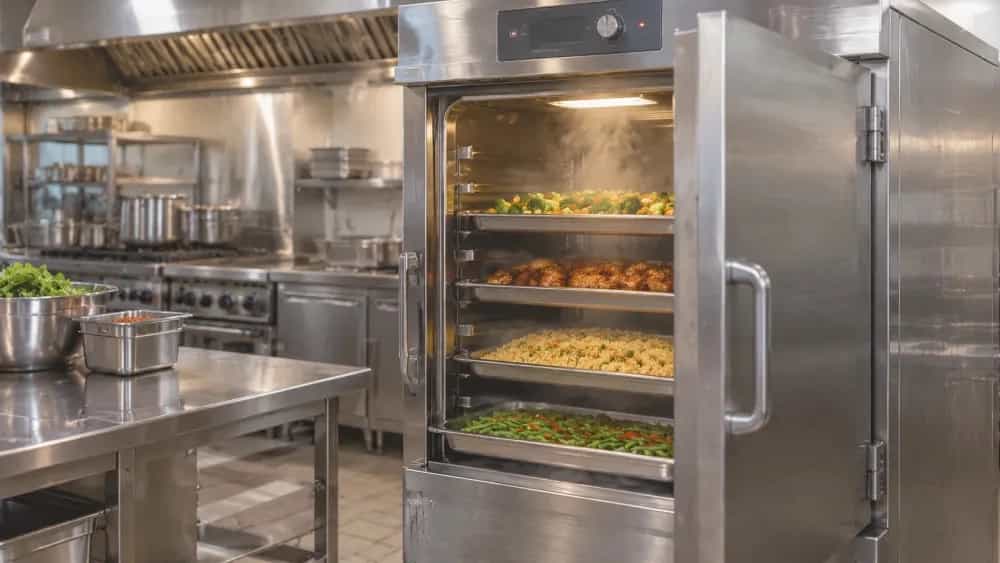
Industrial humid greenhouse is one of the vital equipment in professional kitchens, which is responsible for preserving the taste, texture and natural moisture of food after cooking and before serving. According to our technical reviews in industrial kitchen equipment projects, the decline in the quality of prepared food is usually caused by the drying of protein tissue and excessive moisture evaporation in devices without a humidity control system. In practice, it has been observed that conventional greenhouse systems or so-called "dry hot boxes" cause a sharp drop in food weight and quality, while cabinets equipped with a combined humidifier system, with a standard temperature above 63 degrees Celsius (in accordance with food safety control standards) and controlled steam injection, maintain moisture in the food texture. By using a uniform hot air circulation system, these devices prevent the temperature drop during frequent opening and closing of the doors during peak food serving hours.
Operation mechanism and simultaneous control of temperature and humidity
In the technical structure of these devices, humidity acts as a quality factor and temperature as the main factor of food safety control. Field tests show that powerful heating elements in combination with a stainless steel water tank and air distribution fans create a stable cycle. When food is placed in bain-marie containers or standard trays, the moist air stream flows evenly across all layers. This process prevents the formation of a dry layer on the surface of rice, all kinds of stews and meat, and increases the safe storage time of food without losing its appearance. Failure to use accurate control systems in various samples of the market often leads to the phenomenon of re-cooking and crushing the texture of food, which has been resolved in the engineered designs of Steel Khani.
The challenges of quality loss and the importance of the cooking to serving cycle
One of the biggest challenges for managers of restaurants, hotels and hospitals is managing the high volume of cooked food during peak hours and preventing it from spilling over. Due to the lack of ability to accurately adjust the humidity percentage, traditional heating equipment causes the edges of the food to dry or change its color. Our practical experience shows that careful separation of compartments, insulation of double-walled bodies with compressed rock wool and the use of silicone gaskets minimize energy losses. This technology allows the operator to keep protein products ready to serve for hours without losing the interstitial water and initial taste.
Technical comparison of industrial wet and dry greenhouse systems
Technical and functional features | Traditional dry greenhouse (Hot Box) | Steelkhani industrial wet greenhouse |
Humidity supply system | No humidity system (dry) | Steel water tank with precise adjustment capability |
Preserving the texture and taste of food | Drying of food surface and weight loss | Maintaining freshness, interstitial water and primary texture |
Temperature control | Mechanical thermostat Simple | High precision digital and synchronized sensors |
Primary use | Limited storage or dry fast food | catering, hotels, hospitals and large restaurants |
Key points in the maintenance and optimal use of the device
In order to obtain the best results from the humid greenhouse equipment, it is necessary to observe several technical principles: First, it is very important to preheat the cabin before placing the food containers, and the device should not be loaded cold. Second, the use of purified water in the humidifier tank prevents premature sedimentation of elements. Third, periodic cleaning and daily emptying of the water tank ensures the health standards of the work environment and maximizes the life of the electronic and mechanical parts of the device.